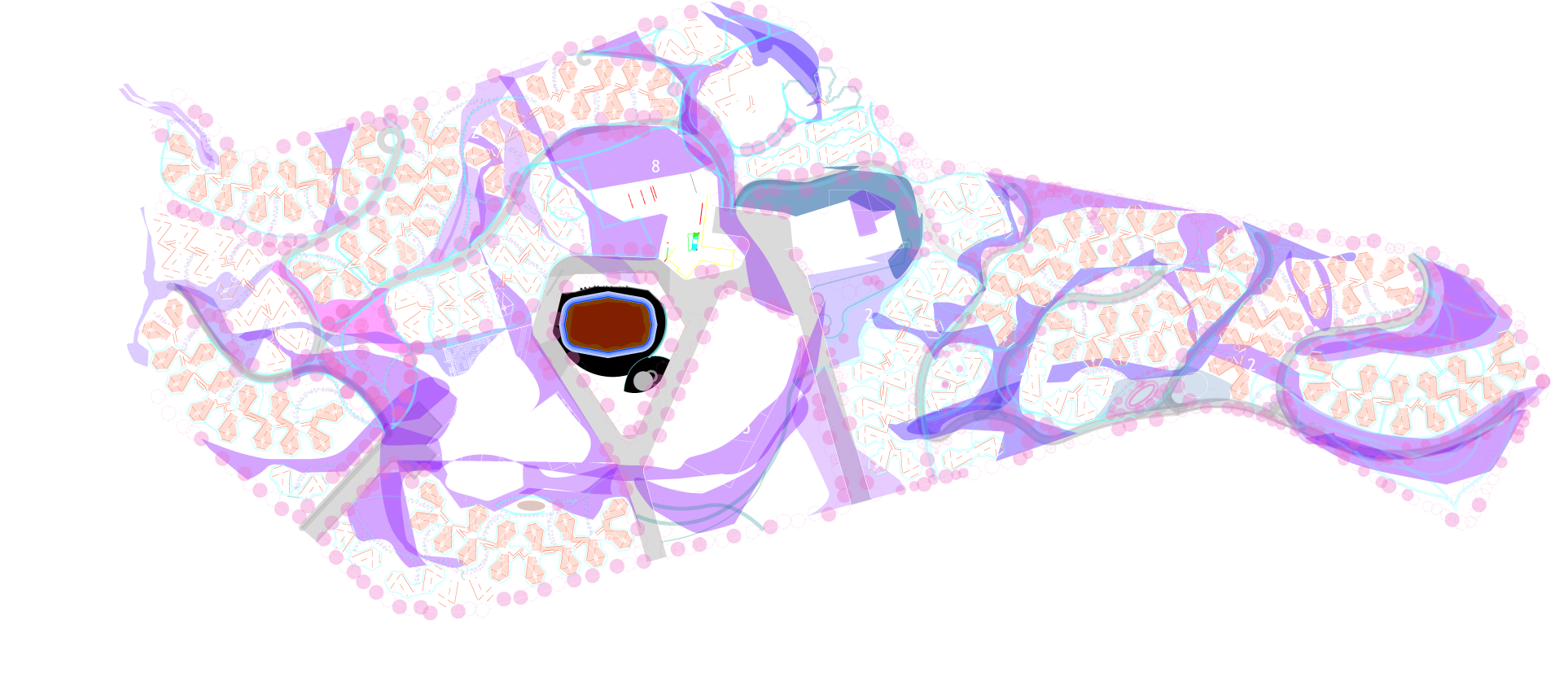
Sprawl can be understood on a theoretical level through a study of its signs and symbols, but to actually make sense of sprawl is its acceptance by the subject - user. In our modern cities, we have managed to sprawl every available direction. In the process, we loose all sense of proportion and scale. Our cities have become inhumane places where we experience our surroundings but they are like surreal, cold storage -sets that we have nothing to do with and which disown us in turn when they are in fact our houses and workplaces. They force us to dwell unpoetically.
When the scale is brought down to a comprehensible level comfortably measurable in units of the body the complex will achieve qualities of intricacy and detail of a fractal scale that would not make the subject feels miniscule.
The most direct step towards this is the avoidance of direct through vehicular traffic on grid iron roads and thus design of housing clusters to allow for a higher degree of human interventions in creating pedestrians walkways, thoroughfare and shortcuts.


The living and work spaces can be brought together by many means- by simple juxtaposition, by placing in close proximity within same complex / campus.
A closer juxtaposition can be achieved by using a Mobius strip to represent the dialectic. A mobius strip itself embodies the contradiction of an object with two sides but one surface. If we accept the two sides to represent the living and working facets of the subject's life, they can be brought together by the mobius, so that one surface abruptly within the other and then disappears elsewhere just as naturally. The mobius allows the opportunities to coexist, interact and yet remain aloof.


                                                site plan


                                                                              part site plan


                      elevation


thesis 

We live in cities, planned, designed, what we refer to, Cities now no longer are planned, they grow, producing fantastic amount of energy and power, for itself, for the ‘people’ in it. Calling out for more and more people, to consume this energy. Hence no need for planning.                         
City is generally associated with the sub-urbs around it enclosing the city into tiny box of complexities and all, the entire infrastructure one could imagine. This infrastructure leading its way through the unseen tunnels and roadways, reaching out to these sub-urbs and fulfilling the unstoppable hunger for energy, thus city is lost in this battlefield for energy and power.  City, when it grows the physical barrier of it still remains and what gets added on, every other time is one more sub-urb. These sub-urbs are planned and designed, considering every new amenity provisions are made.


Make a Free Website with Yola.